WORLD NEWS
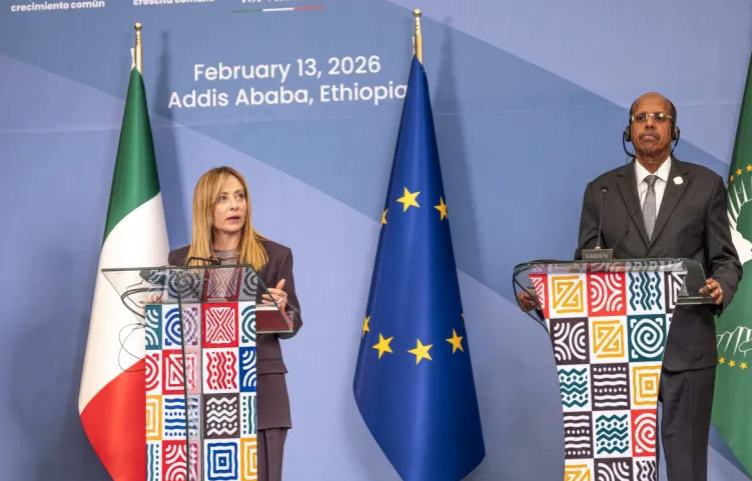
The chairman of the African Union (AU) Commission, Mahmoud Ali Youssouf, has called for an end to what he described as the “extermination” of the Palestinian people, as dozens of African heads of state convened for the AU’s 39th summit in Ethiopia’s capital, Addis Ababa.
“In the Middle East, Palestine and the suffering of its people also challenge our consciences. The extermination of this people must stop,” Youssouf said in his address on Saturday. He further urged the lifting of the Israeli blockade on humanitarian goods entering the besieged Palestinian territory, stressing that international law and humanitarian law must remain the foundation of the global order.
Focus on Conflict and Governance
The two-day summit of the AU’s 55 member states is expected to address pressing regional issues, including ongoing conflicts, governance challenges, democratic backsliding, and climate change impacts — particularly water sanitation and water-linked climate shocks, which form this year’s central theme.
Youssouf also called for “silencing the guns” across Africa, highlighting active conflicts in Sudan, the Sahel region, eastern Democratic Republic of Congo (DRC), and Somalia.
As the summit opened, reports emerged of at least four explosions near a base of the Sudanese Armed Forces (SAF) in Dilling, South Kordofan, allegedly targeted by drones from the Rapid Support Forces (RSF), underscoring the fragile security situation in the region.
UN Calls for African Representation
In his address, United Nations Secretary-General Antonio Guterres praised the AU as a “flagship for multilateralism” amid growing global division and mistrust. He reiterated calls for a permanent African seat on the UN Security Council, describing Africa’s exclusion as “indefensible.”
“This is 2026, not 1946. Whatever decisions about the African world around the table, Africa must be at the table,” Guterres said.
Water and Climate at the Forefront
Welcoming leaders to Addis Ababa, Ethiopian Prime Minister Abiy Ahmed emphasised water conservation and responsible water management as central to development and stability.
“Water is more than just a resource. It is a foundation of development, innovation and stability,” he said.
Water issues intersect with major disputes and crises across the continent — from tensions between Egypt and Ethiopia over the Nile, to deadly farmer-herder conflicts in Nigeria, to protests in Madagascar over service delivery, and health epidemics following floods and droughts.
A Continent at a Crossroads
Africa, home to approximately 1.4 billion people — nearly a fifth of the global population — has a predominantly young demographic, with around 400 million aged between 15 and 35. Yet it also faces governance challenges, including long-serving leaders and a rise in military coups, particularly in West African nations such as Mali, Burkina Faso, Guinea, Niger, and Guinea-Bissau.
Observers say this year’s summit presents an opportunity for African leaders to align continental priorities with global partners, amid shifting geopolitical alliances and debates over a changing world order.
As wars rage in Sudan and the DRC, and humanitarian needs mount across the continent, leaders gathering in Addis Ababa face mounting pressure to deliver tangible progress on peace, governance, and sustainable development.
-
Rubio Calls U.S. “Child of Europe” at Munich S...
U.S. Secretary of State Marco Rubio calls America a “child of Europe” at Munich Securi...
-
Iran Declares Missile Program a Red Line, Warns Ag...
Iran’s senior adviser Ali Shamkhani calls the country’s missile program a “red lineâ...
-
Drone Strikes Kill Civilians in Ukraine and Russia...
Drone strikes leave one dead in Ukraine’s Odesa and one in Russia’s Bryansk as Zelensk...
-
Indian National Pleads Guilty to Plotting Assassin...
Nikhil Gupta, 54, pleads guilty in US District Court for the Southern District of New York...
-
US Judges Rebuke Trump Immigration Policy in 4,400...
More than 400 federal judges have ruled 4,400+ times since October that the Trump administ...