LEGAL
Detailed Report
-
The Tale of Two Enclaves: A stark geopolitical divergence has emerged between the state policies of India and Pakistan regarding prime colonial-era public lands. Last week, the Indian government ordered the historic Delhi Gymkhana Club (established in 1913) to completely vacate its premises by June 5, invoking a public-purpose clause to resume state ownership of the land and its buildings. Conversely, across the border, the grander Lahore Gymkhana continues to operate undisturbed on 112 acres of the most expensive real estate in Punjab, paying a token lease amount that critics label a textbook example of institutionalized elite capture.
-
The Economics of the Giveaway: Ringed by Lahore's ultra-premium transport veins—The Mall, Jail Road, and Zafar Ali Road—the market value of the Gymkhana estate has been officially calculated at a staggering Rs218.2 billion. Despite a 2023 government policy mandating that elite clubs pay at least a tenth of market value (which would equal Rs400 million annually), the Lahore Gymkhana pays a total lease rent of just Rs5,000 per year (approximately Rs417 per month). This translates to less than 50 paisas per kanal for land whose fair commercial rent is valued at Rs4.36 billion annually. Furthermore, the club has illegally fenced off an additional $3.5\text{-acre}$ cricket ground inside the public Bagh-e-Jinnah (Lawrence Gardens) without any formal grant, lease, or rent structure.
The Admissions of Guilt & Public Funding: When summoned by the Provincial Assembly, the club's administration admitted that its sprawling clubhouse, golf courses, swimming pools, and guest blocks were constructed without recorded permissions from the Board of Revenue. Compounding the financial anomaly, the club has failed to pay even its nominal Rs5,000 rent since 2011. While the institution fiercely defended its status as a "private entity" in the Lahore High Court to evade Right to Information (RTI) queries, public ledgers reveal it has accepted Rs64 million in direct grants from the public purse across the tenures of four separate heads of government (Zia-ul-Haq, Nawaz Sharif, Pervaiz Elahi, and Shehbaz Sharif).
-
The Circle of Self-Preservation: The investigation highlights why the lease—hastily extended in 1996 to run until the year 2050—remains untouched. By its own charter, the club grants automatic membership to every civil servant of Grade 18 and above, alongside commissioned military officers. This creates a systemic conflict of interest: the very bureaucratic cadres within the Colonies Department, the Board of Revenue, and the Deputy Commissioner's office responsible for pricing, valuing, and leasing state land are themselves the card-holding beneficiaries of the club's luxury fairways.
-
Two-Tiered Enforcement: The state's protective inertia toward the Gymkhana stands in sharp contrast to its aggressive anti-encroachment operations against the urban poor. Over recent months, the Capital Development Authority (CDA) and the newly formed Punjab Enforcement and Regulatory Authority (PERA) have deployed bulldozers to flatten katchi abadis (informal settlements) in Islamabad and Lahore, leaving over 25,000 low-income residents homeless in Muslim Colony alone in open defiance of a 2015 Supreme Court stay order. Street vendors and small-scale traders face immediate fines and seals, highlighting a system where the state administrative machinery moves with ruthless efficiency against the weak while stalling for the powerful.
Comparative Land & Financial Matrix
| Operational & Economic Parameters | Current State Reality (Lahore Gymkhana) | Fair Market Value / Policy Standard |
| Total Main Estate Land Area | 1,12 Acres (1,091 Kanals / 21,820 Marlas) | Retains an unrecorded surplus of 3 Kanals & 16 Marlas |
| Current Annual Lease Rent | Rs5,000 total ($\sim$ Rs417 per month) | Unpaid since 2011 according to official revenue notices |
| Assessed Land Capital Value | Rs200 Million per Kanal | Rs218.2 Billion total real estate value |
| Standard Caretaker Policy Rent | Shaved down 90% via May 2023 law | Rs400 Million annually (10% market rate) |
| Fair Market Annual Rent | Rs200,000 per Marla | Rs4.364 Billion annually |
| State Financial Injections | Rs64 Million in public grants (1985–2014) | Claimed to receive zero public funds |
The Assembly's Blueprint for Reclamation
Despite intense internal resistance, an elected Assembly committee has cracked open the secrecy surrounding the club. By making the hearings public, legislators obtained a decisive legal opinion from the Law and Parliamentary Affairs Department:
-
Clause 6 Power: The state retains the absolute right to terminate the 1996 lease at any time by serving a standard six months' notice.
-
Clause 8 Liability Protection: Upon termination, the government is legally bound to pay zero compensation to the club for any permanent structures, halls, or guest blocks built on the land.
-
The Environmental Remedy: Environmental advocates and assembly members have urged the executive to bypass commercial re-leasing and convert the entire 112 acres into a dense, native Miyawaki public forest. In a city heavily plagued by hazardous winter smog, replacing an exclusive golf fairway serving a few hundred individuals with a massive urban forest would provide a critical green lung for millions of citizens. However, the final pen rests with the provincial executive—leaving the ultimate fate of the land resting on whether the bureaucracy will sign an order against its own enclave.
-
Punjab Food Authority Seizes and Destroys 1,200 kg...
The Punjab Food Authority (PFA) foiled a major smuggling attempt near the Thalian Motorway...

-
Hill Park Land Grab Infighting: KMC Suspends Deput...
The Karachi Metropolitan Corporation (KMC) has suspended Deputy Director Land Nauman amid ...
.jpg)
-
Karachi Hill Park Inquiry: KMC Exposes Forged Appr...
Karachi Mayor Murtaza Wahab has announced a major breakthrough in the Hill Park land dispu...
.jpg)
-
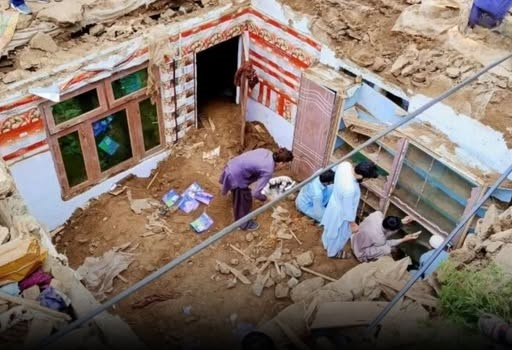
Tragedy in Shangla: Six Children of Same Family Ki...
Six children from the same family lost their lives and another was critically injured earl...
-
Future in Limbo: Exam Boycott by Karachi Universit...
Nearly 50,000 students at Karachi University have been left stranded as a faculty exam boy...