WORLD NEWS
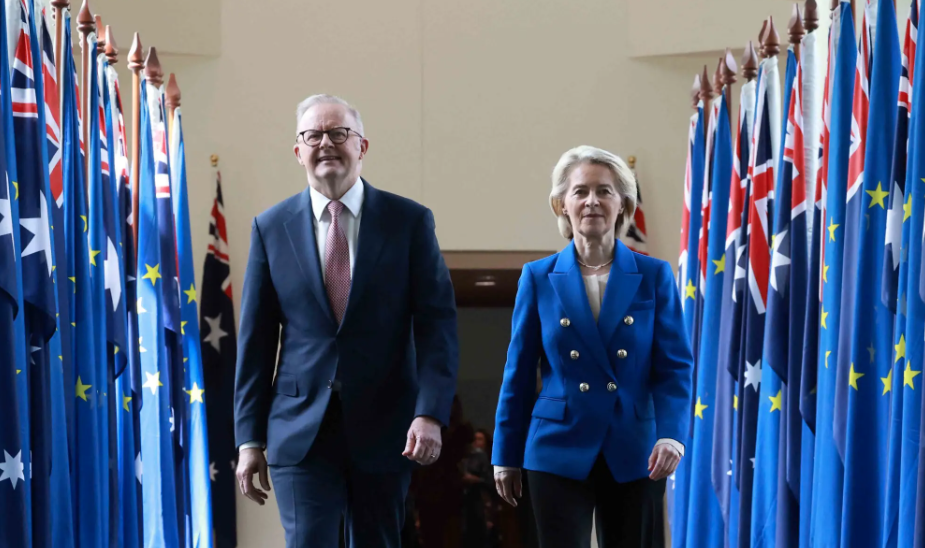
The European Union and Australia finalized a long-awaited free-trade agreement on Tuesday, alongside commitments to strengthen defence cooperation and secure access to critical rare-earth minerals in the face of global trade and energy uncertainties.
The agreement comes as EU President Ursula von der Leyen visited Australia, with both sides navigating energy vulnerabilities heightened by the ongoing US-Israel war on Iran.
After eight years of negotiations, the deal overcame key sticking points, including the Australian use of European geographical names and beef export quotas. Australian winemakers will be allowed to use the term “prosecco” domestically, but exports must stop after 10 years. Certain names like feta and gruyere can continue domestically if used for at least five years.
European carmakers will benefit as Australia raised the luxury car tax threshold for electric vehicles, with three-quarters now exempt, creating incentives for EU exports.
Von der Leyen described the agreement as “fair” for both sides, adding that EU-Australia cooperation is essential to mitigate over-reliance on critical suppliers such as China for rare-earth minerals. “We cannot be over dependent on any supplier for such crucial ingredients, and that is precisely why we need each other,” she said, also emphasizing that the new defence partnership ensures shared security commitments.
China responded through its foreign ministry, urging the EU to avoid “zero-sum thinking” and protectionist measures. Spokesman Lin Jian stressed a rational and objective view of China’s development in response to von der Leyen’s comments.
Under the deal, EU exports to Australia are expected to grow by a third over the next decade. The quota for Australian beef into the bloc will increase more than tenfold, though the Australian National Farmers’ Federation expressed disappointment, arguing the outcome provides limited benefits for key agricultural commodities.
Last year, EU firms exported €37 billion (US$42.9 billion) in goods and €31 billion in services to Australia. The deal is projected to add AU$7.8 billion (US$5.4 billion) to Australia’s GDP by 2030.
The trade agreement is part of broader diversification efforts: Australia seeks new markets after previous disputes with China and US tariffs, while the EU aims to counteract US levies and Chinese export controls.
Von der Leyen’s visit was overshadowed by the Middle East conflict, which has driven oil prices higher. She called for an immediate end to hostilities, noting the “critical” situation for global energy supply chains. Australia, heavily reliant on imported fuel, has also felt the impact of the energy squeeze.
The EU-Australia deal reflects a strategic effort by both partners to strengthen economic, security, and technological resilience amid rising global uncertainties.
-
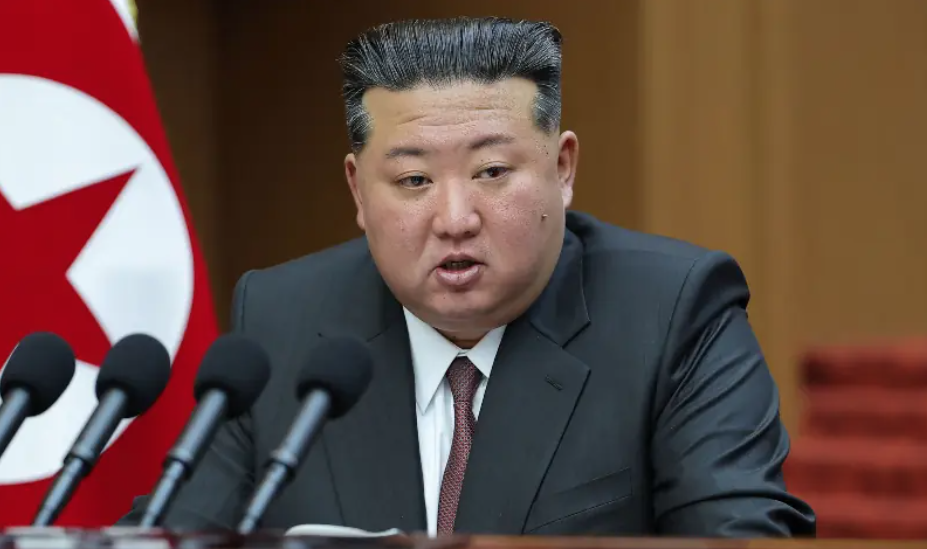
Kim Jong Un Vows to Keep Nukes, Labels South Korea...
North Korea’s Kim Jong Un reaffirms nuclear arsenal, calls US actions “state terrorism...
-
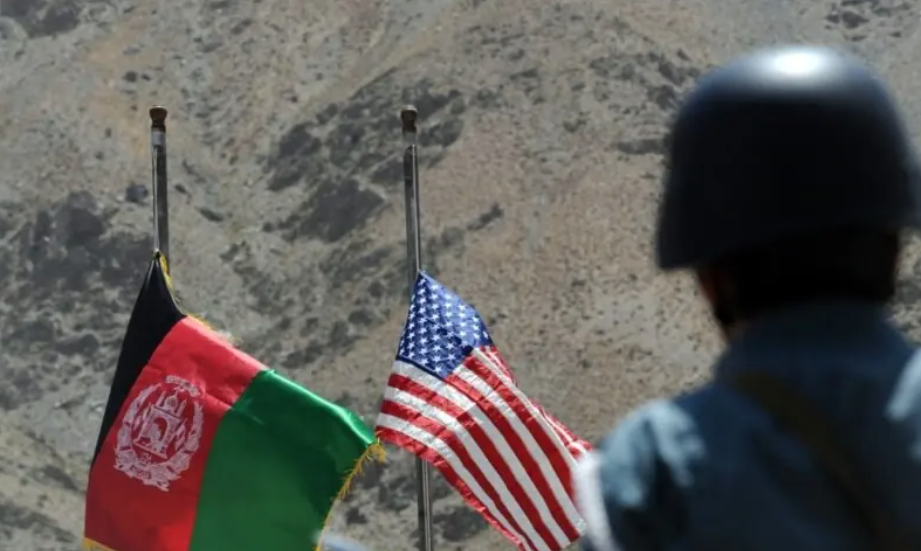
Afghan Taliban Frees US Researcher Dennis Coyle Af...
Afghan Taliban releases US linguist Dennis Coyle after over a year in detention. UAE helpe...
-
Starmer Denies Iran Threat to UK, Calls for Calm o...
PM Keir Starmer says Britain is not a target of Iran amid Middle East tensions, stresses c...
-
Indonesia Refuses $1 Billion Contribution to Gaza ...
Indonesian President Prabowo Subianto says Jakarta will provide peacekeeping forces in Gaz...
-
Reports Suggest Potential US-Iran Meeting in Islam...
Israeli media reports a possible US-Iran meeting in Islamabad this weekend as officials se...