WORLD NEWS
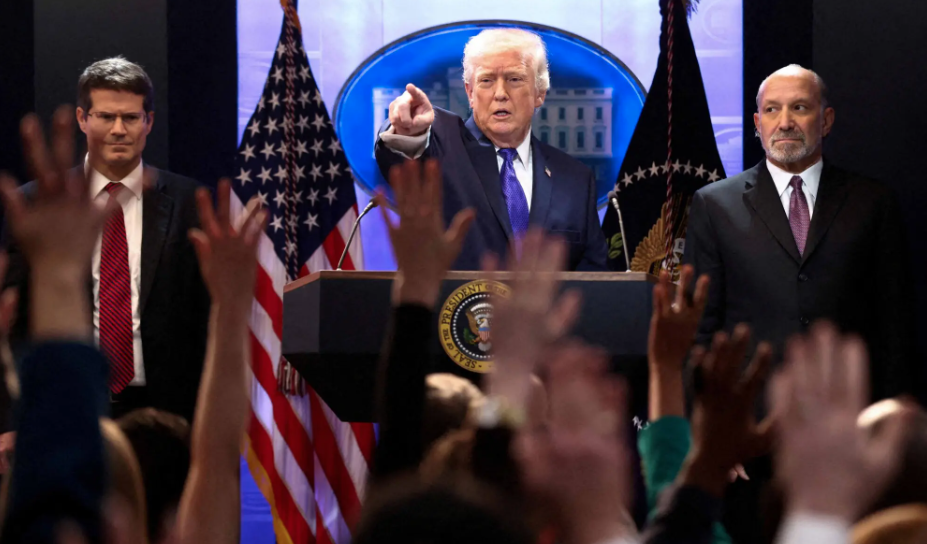
US President Donald Trump announced on Saturday that he is raising worldwide tariffs on goods entering the United States from 10 per cent to 15 per cent, effective immediately.
The decision comes a day after the Supreme Court of the United States largely struck down his sweeping tariff measures, ruling that the emergency powers law cited by the administration does not grant the president authority to impose such broad import duties.
In a post on Truth Social, Trump described the court’s ruling as an “extraordinarily anti-American decision” and said the administration would raise import levies “to the fully allowed, and legally tested, 15pc level.” He added that in the coming months, his administration would determine and issue new legally permissible tariffs as part of what he called the continued process of “Making America Great Again — GREATER THAN EVER BEFORE.”
On Friday, following the court’s decision, Trump had ordered an immediate 10 per cent tariff on all imports in addition to any existing duties. Under the International Emergency Economic Powers Act (IEEPA), the president is allowed to impose tariffs of up to 15 per cent for 150 days, though such actions may still face further legal challenges.
The conservative-majority Supreme Court ruled that the IEEPA “does not authorise the President to impose tariffs,” marking one of the most significant judicial setbacks for Trump since returning to the White House last year.
International reaction to the ruling and the subsequent tariff hike has been mixed. Canada welcomed the court’s decision, reiterating that the US levies were “unjustified.” Meanwhile, European governments, including the United Kingdom and Germany, as well as the European Union, said they were analysing the ruling carefully while maintaining contact with Washington.
Tariffs have been central to Trump’s economic and foreign policy strategy, forming the backbone of a global trade war launched during his second term. The policy has strained relations with key trading partners, unsettled financial markets, and contributed to global economic uncertainty.
The administration had previously projected that the tariffs could generate trillions of dollars in revenue over the next decade for the United States, which remains the world’s largest economy. However, the government has not released updated tariff collection data since December 14, 2025.
The latest move signals that trade tensions may intensify further as legal battles and diplomatic negotiations continue.
-
US Ambassador to Israel Mike Huckabee Sparks Contr...
US Ambassador Mike Huckabee suggests Israel could expand to biblical borders, from the Nil...
-
Supreme Court Strikes Down Trump’s Global Tariff...
The U.S. Supreme Court blocks former President Donald Trump’s sweeping global tariffs, r...
-
Brazil, India Sign Landmark Agreement on Critical ...
Brazil and India have inked a deal to boost cooperation on critical minerals and rare eart...
-
Iran to Submit Nuclear Deal Proposal to US Amid Tr...
Iran says it will present its nuclear deal draft to the US in coming days, disputing Trump...

-
Europe’s Leading Defence Powers Join Forces to D...
France, Germany, Italy, Poland & UK team up on €multi-million project to develop low-cos...