LEGAL
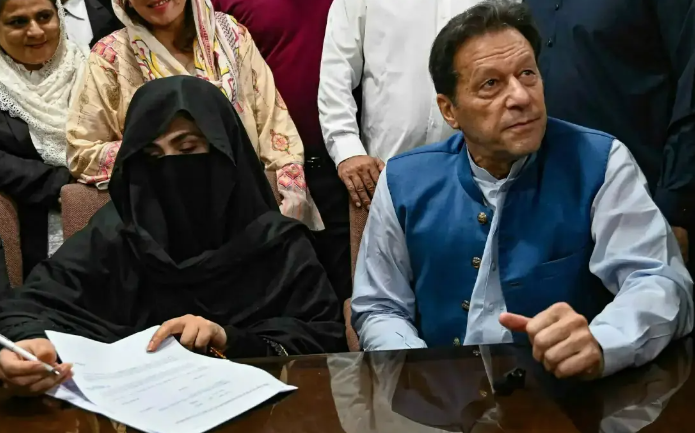
Former prime minister and Pakistan Tehreek-e-Insaf (PTI) founder Imran Khan and his wife Bushra Bibi have filed petitions before the Islamabad High Court (IHC) seeking suspension of their sentences in the Toshakhana-2 (Bulgari jewellery) case, citing serious medical concerns and alleged legal infirmities in the trial court’s verdict.
The petitions were filed by Advocate Salman Akram Raja along with Barristers Salman Safdar, Gohar Ali Khan, and Qausain Faisal Mufti under Section 426 read with Section 561-A of the Criminal Procedure Code 1898. The petitioners have prayed for their release until the final adjudication of their criminal appeal.
Trial Court Conviction
On December 20, 2025, the Special Court Central-I convicted the couple, awarding them 10 years’ simple imprisonment under Section 409 of the Pakistan Penal Code (criminal breach of trust by a public servant) along with a fine of Rs16.425 million.
Additionally, both were sentenced to seven years’ simple imprisonment under Section 5(2) of the Prevention of Corruption Act, 1947.
Double Jeopardy Argument
The petition contends that convicting the couple under two separate enactments for the same alleged act violates the principle of double jeopardy as enshrined in Section 26 of the General Clauses Act, 1897.
“Such dual conviction for the same alleged act is wholly beyond the mandate of law,” the petition argues, maintaining that at most, conviction could have been recorded under only one of the two provisions.
Medical Grounds
A significant part of the plea focuses on Imran Khan’s health. Referring to proceedings before the Supreme Court of Pakistan on February 10, 2025, the petition notes that a medical report submitted by Dr Muhammad Arif of the Pakistan Institute of Medical Sciences (PIMS) revealed severe damage to the former prime minister’s right eye.
According to the report, a blood clot has left him with only 15 percent vision in the affected eye, and adequate treatment cannot be provided within jail premises.
Legal Objections to Conviction
The petition further challenges the trial court’s interpretation that Imran Khan qualifies as a “public servant” under Section 21 of the PPC. Citing PLD 2024 SC 102 and precedent from the Indian Supreme Court, the plea argues that elected holders of public office do not fall within the ambit of “public servant” for the purposes of Section 409 PPC.
The defence also maintained that gifts received from the Toshakhana were retained strictly in accordance with the Toshakhana Policy 2018 after depositing 50 percent of the value exceeding the exemption limit of Rs30,000.
Objections were also raised regarding the treatment of prosecution witness Sohaib Abbasi as an approver, with the petition arguing that mandatory procedures under Section 337 CrPC were not followed. It further claimed that another witness, Syed Inamullah Shah, should have been named as an accused rather than examined as a prosecution witness, alleging a selective and mala fide approach.
Appeal and Early Hearing Requests
The petitioners emphasized that they remained on bail throughout the trial and complied with all court-imposed conditions. Their criminal appeal challenges the conviction on substantial questions of law and fact, arguing that there is no likelihood of an immediate hearing, thereby necessitating suspension of sentence to prevent what they termed a “manifest miscarriage of justice.”
Separately, the former prime minister and his spouse have also filed petitions seeking early hearing of the £190 million corruption case. The registrar’s office is expected to place the matter before a bench next week.
-
Imran Khan Speaks to Sons from Adiala Jail on Supr...
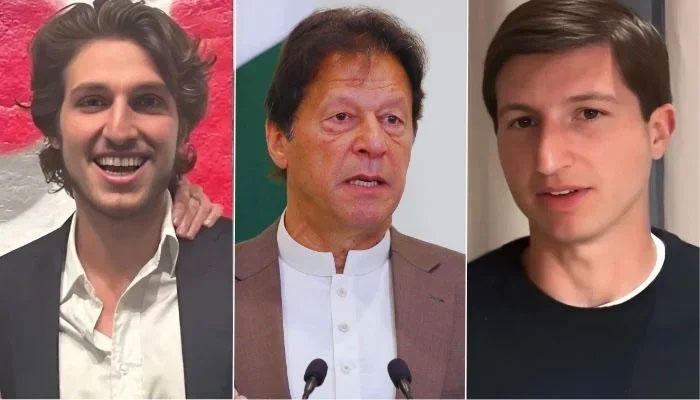
Former PM Imran Khan speaks to sons Qasim and Suleman for over 30 minutes from Adiala Jail...
-
Judicial Commission to Inspect Gul Plaza Tragedy S...
Justice Agha Faisal-led judicial commission to visit Gul Plaza on Feb 14; families of 79 v...

-
FIA Raids Karachi KMC Head Office Over Alleged Waq...
FIA raids Karachi KMC over alleged irregularities in Waqf Property records. Record room lo...
-
Three Arrested for Torturing Traffic Officer in Ta...
In Taunsa Sharif, A traffic officer was attacked after issuing a challan for helmet violat...

-
Supreme Court Orders Eye Specialists, Phone Access...
The Supreme Court has directed authorities to provide Imran Khan access to eye specialists...